On December 13th, 2023, ECHA issued the REF-10 enforcement action report. The main focus of this enforcement project is to comprehensively control chemicals in products (substances, mixtures and articles) within different legislative categories such as REACH regulations, POPs regulations, RoHS directives and toy directives.
This time, 2,407 products from 26 countries were inspected, and the overall nonconformity rate was 18%, of which the nonconformity rate of articles was 20%(395/1970) and that of mixtures was 9%(40/423). For the obligation of information transmission (content above 0.1%) triggered by article 33(1) of REACH, the non-compliance rate is 8%(49/589).
1. The main contents of this law enforcement result are as follows:
1.1 By product category:
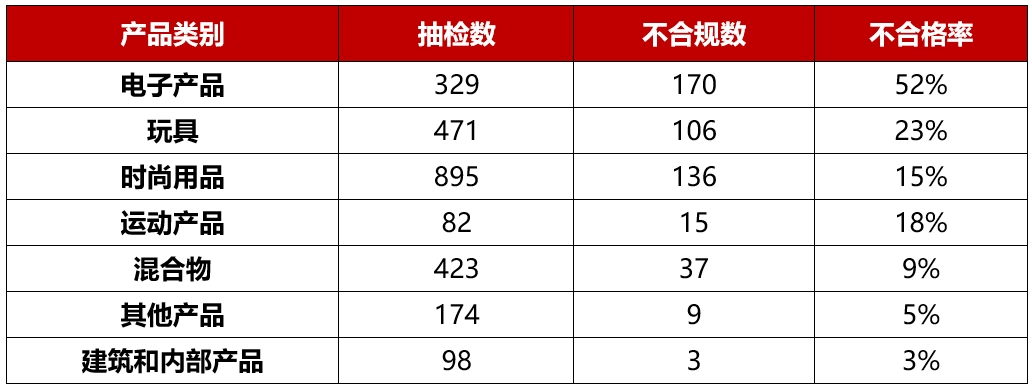
★ Electronic products: such as electric toys, chargers, cables and headphones. 52% of these products were found not to meet the requirements of EU regulations, mainly due to lead in solder, phthalates in soft plastic parts, or cadmium in circuit boards.
★ Sports products: such as yoga mats, bicycle gloves, balls or rubber handles of sports equipment. 18% of these products do not meet the requirements of EU regulations, mainly because the soft plastics contain short-chain chlorinated paraffins (SCCPs) and phthalates, and the rubber contains polycyclic aromatic hydrocarbons (PAHs).
★ Toys: such as bath/water toys, dolls, clothes, game pads, plastic figures, fingertip toys, outdoor toys, slime and child care products. 16% of non-electric toys were found to be out of compliance, mainly due to the discovery of phthalates in soft plastic parts, but there were also other restricted substances, such as polycyclic aromatic hydrocarbons, nickel, boron or nitrosamines.
★ Fashion products: such as bags, jewelry, belts, shoes and clothes. Fifteen percent of these products were found to be unqualified because they contained phthalates, lead and cadmium.
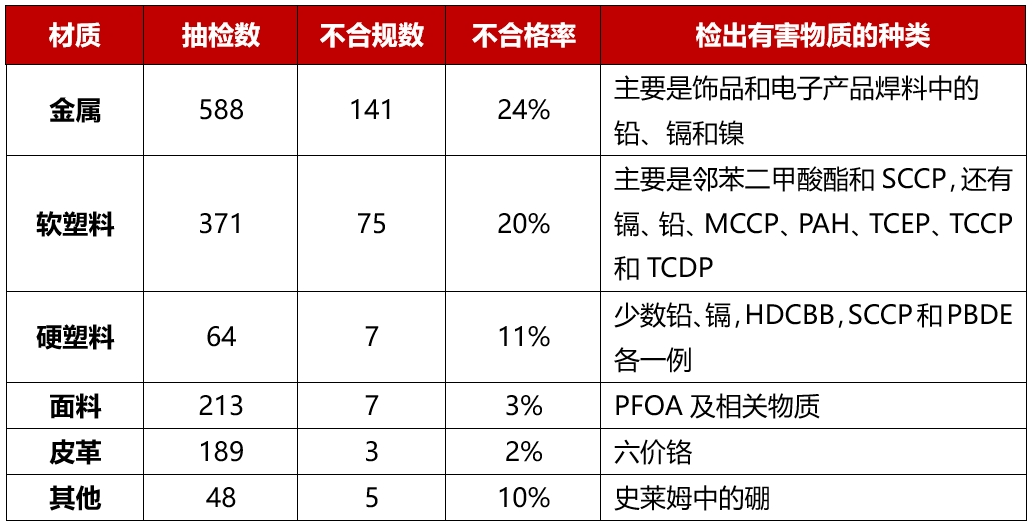
1.2 According to the material category:
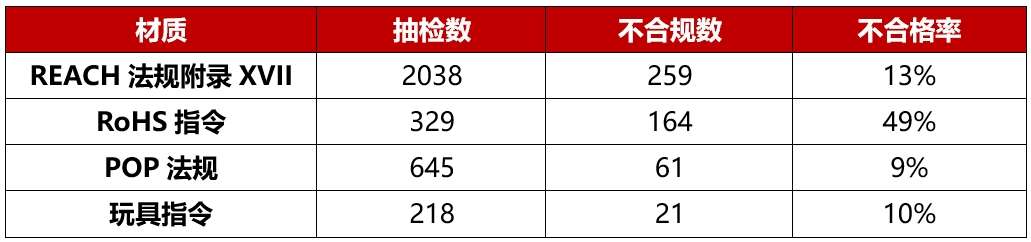
1.3 According to non-compliance regulations:
2. Punishment measures:
Law enforcement measures taken by law enforcement departments for non-compliance mainly include:
★ Written or oral opinions, announcements and instructions;
★ Products are removed from the shelves, recalled and prohibited from being put on the market;
★ Fines, sanctions and criminal proceedings, etc.
3. Future law enforcement trends
At the beginning of December 2023, ECHA Law Enforcement Forum announced the work plan for 2024-2025 in ECHA official website, and determined the enforcement priorities of REACH, CLP, PIC, POPs and BPR (biocide product regulations) at the EU level in 2024-2025. These measures include taking action in areas with high risk of violation, such as online sales, import of goods, classification and labeling or compliance with restrictions. In addition, the work plan also identified imported products as the key inspection targets of the 12th Joint Enforcement Action (REF-12), which will be inspected in 2024 and the enforcement report will be released in 2025.
Warm tips
In this enforcement action, the EU found that a large number of imported products violated regulations, and China products accounted for a high share. Therefore, ZRLK suggested that domestic related export enterprises should pay close attention to the update of laws and regulations in time, actively respond, improve product quality, do a good job in testing related harmful substances, and strengthen the quality control of supply chain to ensure that products can safely enter the European market, reduce violations and avoid unnecessary trade losses. Our company has a wide range of testing fields and a professional and efficient service team, which can help enterprises evaluate the special chemicals regulated in products and make your products meet the corresponding national and international organization standards. If you need it, please feel free to contact us, and our engineers will serve you at the first time!