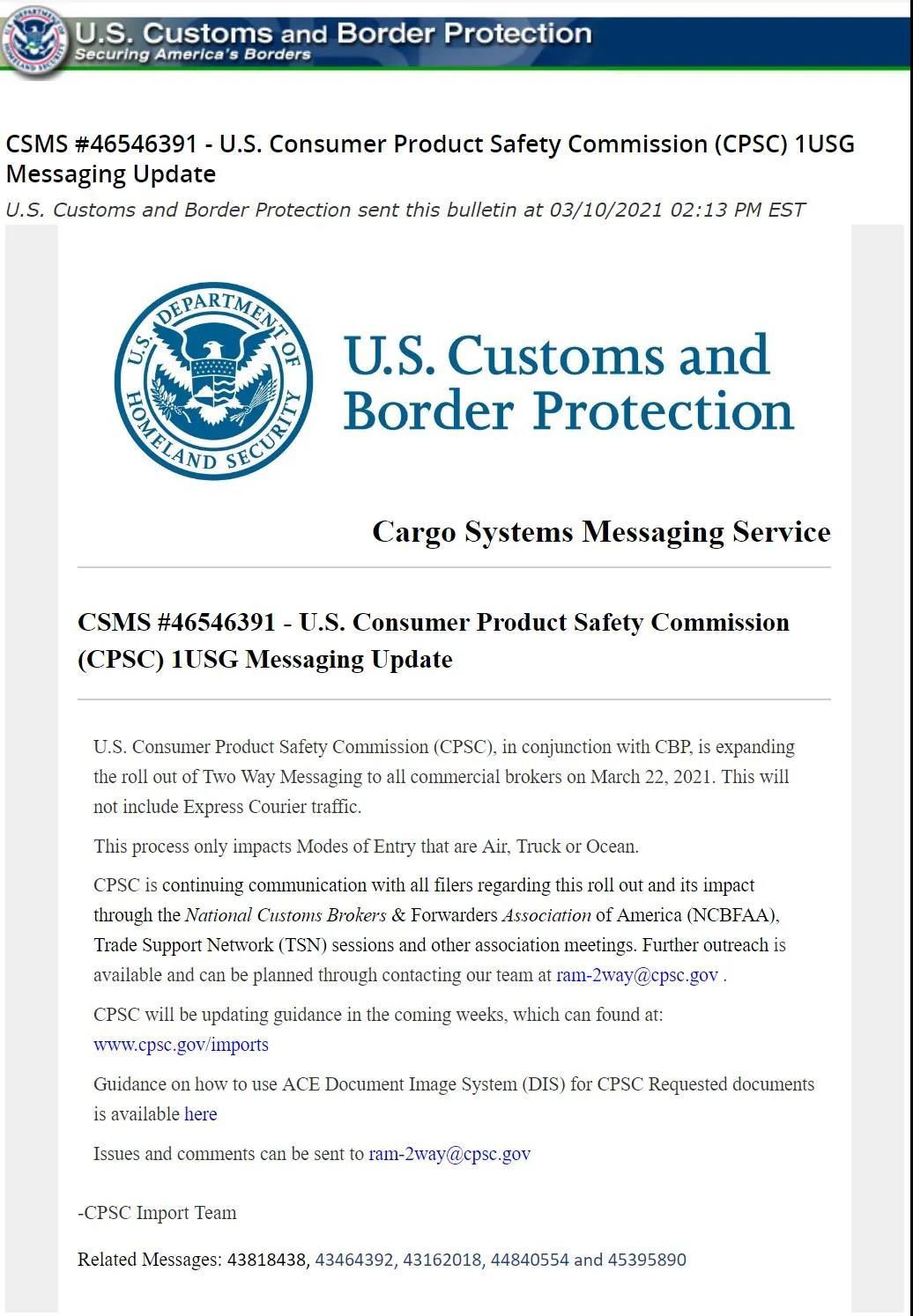
The US CPSC and CBP began reforms on March 22 and will fully implement "Two Way Messaging". All products within their jurisdiction will be marked for review.
Notification display:All goods entering the United States that are transported by air, truck or sea will be marked for review. If there are related products, it is recommended to prepare related documents in advance, such as CPC inspection reports and so on.
The light industrial products generally involved are as follows: multi-layer beds, bicycles, bicycle helmets, lighters, swimming pool ladders, mattresses, children's products (including toys and child care products), etc.
What is CPSC in the United States?
CPSC is an important consumer rights protection agency in the United States. It is the abbreviation of Consumer Product Safety Commission, that is, the US Consumer Product Safety Commission. Its responsibility is to protect the interests of consumers. For those consumer products for which there is no standard to follow, compulsory standards or bans are established. Perform inspections on potentially dangerous products.
U.S. CPSC jurisdiction
The CPSC has a very wide range of supervision, monitoring more than 15,000 consumer products, mainly children's products, household appliances, and other consumer products used in homes, sports, entertainment, and schools. However, products such as vehicles, tires, ships, weapons, alcohol, tobacco, food, medicines, cosmetics, pesticides and medical equipment do not fall within its jurisdiction.
The main responsibilities of CPSC
1. Establish uniform mandatory national standards across the United States;
2. Further regulate the lead content requirements in children's products;
3. A traceability label is affixed to the toy;
4. Transform the voluntary standard ASTM F963 into a mandatory standard;
5. Compulsory third-party testing of certain children's products;
6. Implement control over 8 phthalates in toys and child care products.
What is CPC certification?
Children’s Product Certificate (CPC) is a certificate issued based on test data after a third-party laboratory authorized by CPSC has tested products in accordance with regulations. Applicable to all products targeted at children aged 12 and under, such as toys, cradles, children’s clothing, etc. If produced in the United States, the manufacturer is responsible for providing it, and if it is produced in other countries, the importer is responsible for providing it. In other words, cross-border sellers, as "importers", want to sell products produced in Chinese factories to the United States, and need to provide a CPC certificate to Amazon as a retailer.
Note: CPC certificate must be done by a laboratory authorized by CPSC! Before doing this CPC certification, it is recommended that the seller confirm whether the testing company has the CPSC authorization, this is very important!
Information to be included in CPC Children’s Product Certificate
● Product information covered by the certification
●All CPSC children's product laws and regulations applicable to the product
● U.S. local manufacturer or importer information: including name, address and phone number
● Contact information of test record holder
● Product manufacturing time and place
● Time and place for product testing compliance
● CPSC accredited third-party testing laboratory information: including name, address, contact number
CPSC import common problems of product retention
◆ Why does CPSC issue a detention notice?
The detention notice issued by the CPSC will cancel the U.S. Customs and Border Protection (CBP) as an information channel in the acceptance process and allow importers and/or their brokers to communicate and collaborate directly with CPSC. CPSC wants to control this process.
◆ What information will be included in the "Detention Notice"?
All information related to the detention will be included in the notice, including the reason for the detention, and the contact information of the CPSC investigator responsible for handling the detention.
◆ Who will receive the detention notice?
The detention notice will be sent to the record importer and the customs broker handling the transaction. CBP will receive copies of all detention notices.
◆ Will CPSC keep the detained products?
will not. Any products detained by CPSC will continue to be stored in bonded institutions supervised by CBP.
◆ As the importer of the detained product or the broker for the transaction, can you provide evidence to support the acceptability of the product?
CPSC encourages importers and/or brokers to submit any reasonable test results or other evidence to support the acceptability of the detained products. The detention notice allows the recipient to respond within 5 working days. In some cases, a reasonable extension of the time required to produce the necessary evidence is allowed. CPSC expects importers and/or brokers to respond quickly to speed up the resolution of detentions.
◆ If CPSC detains goods, will the remaining goods that do not contain the detained goods be released?
CPSC only detains the products described in the "Detention Notice". If the importer and/or its broker wishes to obtain the release of the remaining products in the shipment, they should contact CBP.
◆ How long will the detention last?
The US Consumer Product Safety Commission (CPSC) will try to make a decision on the admissibility of the product within 30 days after the detention.
◆ Will CPSC allow the conditional release of goods in lieu of detention?
Yes it is. In some cases, the CPSC will allow the goods to be inspected to be moved to the place of the importer or other locations agreed by CPSC and CBP until the inspection results are available. Any such release is a conditional release and must occur under the supervision of CBP.
◆ If my product is conditionally released, how long will the conditional release period last?
The CPSC will notify the importer of the length of the conditional release period based on specific circumstances, but the usual time limit is 30 days. However, the type of product and the complexity of the inspection are also considered.
◆ Can I export or destroy the goods before the CPSC makes an acceptability decision?
The CPSC may allow this depending on the circumstances. If you choose this result, please contact the CPSC investigator for more information.
◆ Can I request a hearing in accordance with the "Administrative Litigation Law"?
If you choose this option, there will be a considerable delay in detention, and you will continue to bear the risks and costs of the goods.
◆ Will there be protests against CPSC detention?
will not. The CPSC's detention decision was not made in accordance with Article 1499 of Title 19 of the United States Code, and therefore no protest shall be made.
◆ If a batch of goods is separately detained by CBP and CPSC at the same time, will the importer receive notice from these two agencies?
Yes it is. CPSC and CBP will send detention notices separately. However, the issue of CBP detention must be resolved first. If CBP detains the product under its authorization, the CPSC detention will end. If CBP does not discover any violations and releases the product from the detention, the product will not be released to the importer until the CPSC detention is resolved.
◆ How does CPSC hope to communicate the detention notice?
If an email is provided in the input document, the email is preferred.
ZRLK testing is a third-party testing laboratory accredited by the US Consumer Product Safety Commission (CPSC), which can provide a one-stop solution for children's products CPC certification. You are welcome to come to consult!