On February 24, 2022, the European Commission published 12 amending directives in its Official Journal (OJ): (EU)2022/274, (EU)2022/275, (EU)2022/276, (EU)2022/ 277, (EU)2022/278, (EU)2022/279, (EU)2022/280, (EU)2022/281, (EU)2022/282, (EU)2022/283, (EU)2022/284 , (EU) 2022/287, revised the exemption clauses of Annex III of the RoHS Directive (2011/65/EU), mainly related to the exemption of mercury content in lamps, among which the application for extension of many clauses was rejected, respectively 12 months or 18 month transition period, the directive will take effect on the 20th day after it is issued.
The revised terms are as follows:
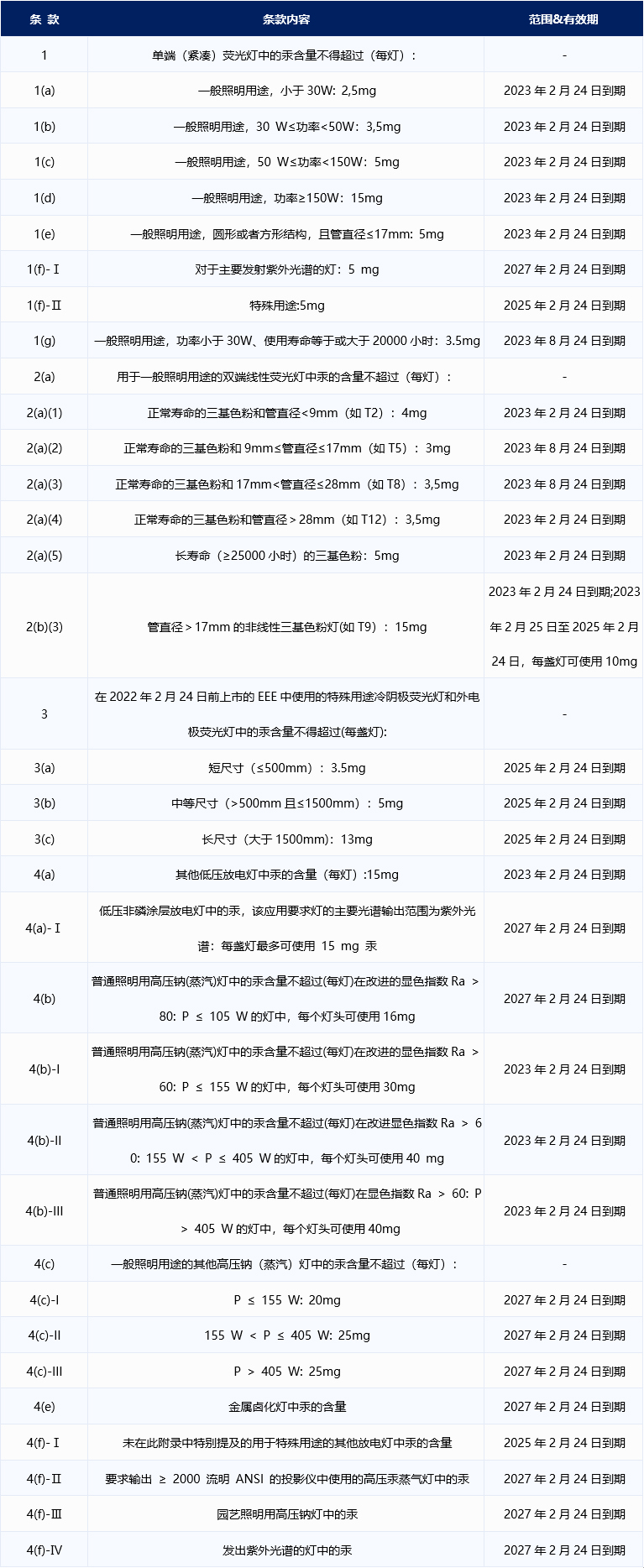
Note: Exemption means that certain materials in electronic products can temporarily not meet the limit requirements of the RoHS Directive. The list of exemptions from the RoHS2.0 Directive is listed in Annexes III and IV of 2011/65/EU, of which Annex IV is the exemption clause for the application of medical and monitoring control equipment, and Annex III is the exemption clause for all electrical and electronic equipment applications. .
Maximum exemption period rule - 2011/65/EU Article 5(2)
For the exemptions listed in Annex III on July 21, 2011, the maximum exemption period is 5 years for products in categories 1-7, 10, 11 in Annex I, and the maximum exemption period for products in categories 8 and 9 is 7 years years, unless a shorter period is specified.
For exemptions listed in Annex IV on July 21, 2011, the maximum exemption period is seven years, unless a shorter period is specifically indicated.
Exemption extension application rules - 2011/65/EU Article 5(5)
A renewed application should be made 18 months before the expiry of the waiver. Existing exemptions remain in effect until an update decision is made.
Exemption from revocation transition period rules - 2011/65/EU Article 5(6)
When an application for an exemption is denied or an exemption is withdrawn, the exemption is valid for at the earliest 12 months from the date of the decision and at the latest 18 months from the date of the decision.
Reminder
The update of RoHS exemption clauses has a great impact on the electrical and electronic related industries, especially whether some exemption clauses frequently used by enterprises are extended or not, which may directly affect the production process and business activities of enterprises. In order to ensure the compliance of entering the EU market, ZRLK recommends that relevant companies always pay attention to the updates of the exemption clauses of the RoHS Directive, make reasonable arrangements for production plans and material substitution, and avoid compliance problems caused by the expiration of exemptions for products exported to Europe.